Forecasted report
The Inventory forecasted report provides a real-time view of projected stock levels, helping businesses manage their inventory efficiently. This report is beneficial for planning and decision making, ensuring stock availability for upcoming sales, manufacturing, and replenishment activities.
WARNING
The forecast report is only available on products where inventory is being tracked, commonly referred to as a storable product.
Navigating the forecast report
The forecast report can be accessed via the Inventory, Purchase, Manufacturing, and Sales apps.
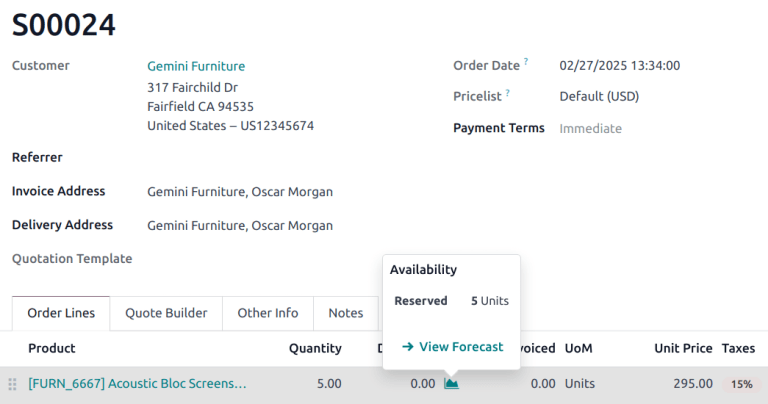
To access the report, click the fa-area-chart Forecasted smart button on a product form. Alternatively, the report can be accessed from a sales order (SO) or purchase order (PO) by clicking on the fa-area-chart(Graph) icon next to the product, then selecting oi-arrow-rightView Forecast.
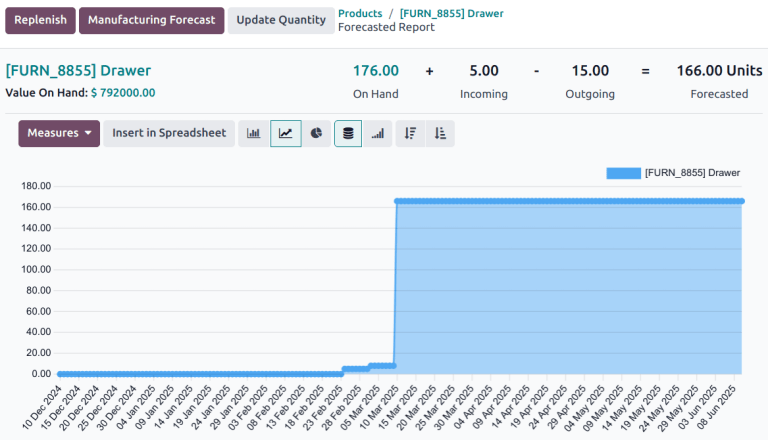
The forecasted report consists of a graph and a table. The graph visually represents stock movements over time. The following information is displayed:
On Hand: current stock physically available in the warehouse.Incoming: quantities expected from confirmed purchase orders or manufacturing orders.Outgoing: quantities reserved for sales orders or other outgoing operations.Forecasted: projected stock levels based on confirmed and planned operations.
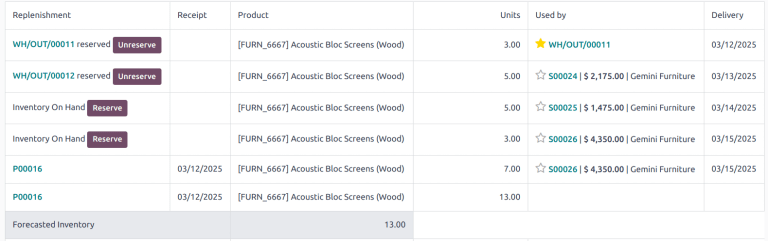
The table provides detailed metrics regarding operations, including:
Replenishment: Shows reserved quantities, especially useful for multi-step operations.Receipt: The date of receipt for the items.Units: The number of units involved in each operation.Used by: The operation the stock is allocated for.Delivery: The scheduled or expected date of stock movement.Forecasted Inventory: The forecasted stock levels.Forecasted with Pending: The updated stock levels with the pending stock movements considered.
Reserve and unreserve products
Users can reserve or unreserve products directly from the forecasted report, ensuring stock allocation aligns with operational needs.
Replenish products
Click the Replenish button at the top of the report to open the Product Replenish pop-up. From here, products can be replenished through purchase orders from vendors, or manufactured. Select the Quantity, Preferred Route and Vendor, before clicking Confirm.
Manufacturing forecast
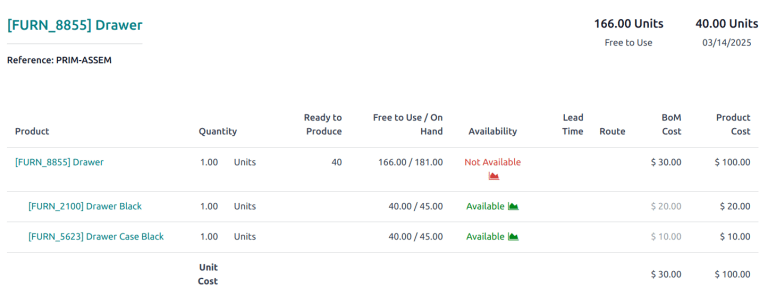
To view the availability of manufactured products, click the Manufacturing Forecast button. This displays the forecasted stock levels for raw materials, showing how much are expected to be consumed for upcoming manufacturing orders.
The manufacturing forecast identifies component shortages before they can impact manufacturing timelines, and helps to align manufacturing activities with sales demands.
Update quantity
To manually update the quantity of a product, click Update Quantity. This opens the Change Product Quantity pop-up. Confirm the correct product variant is selected in the Product field, then enter the appropriate value in the New Quantity on Hand field. Click Apply when finished. The report then updates to reflect the new product quantity.
Multi-step reservation
Reserved quantities for multi-step incoming and outgoing shipments are indicated on in the Replenishment column on the table of the report.
Stock in Transit refers to products that have been received, but are in transit to their input or quality control locations. Free Stock in Transit refers to available products received in the input location, but not yet placed in stock.
Operations affecting the forecast report
The forecast report is influenced by various operations, each impacting stock levels differently. Scheduled delivery dates, planned manufacturing dates, and expected arrival dates all affect the forecast of inventory.
Requests for Quotation (RFQs) do not immediately impact the forecast report, as the products are not confirmed for replenishment. POs (purchase orders), however, do affect the report as the products are expected to arrive after the PO (purchase order) has been confirmed.
Confirmed SOs (sales orders) decrease the forecasted stock, adjusting the report based on the scheduled delivery date. Confirmed manufacturing orders (MOs) affect the forecasted stock for both raw materials and finished goods.
Use cases
Negative quantity
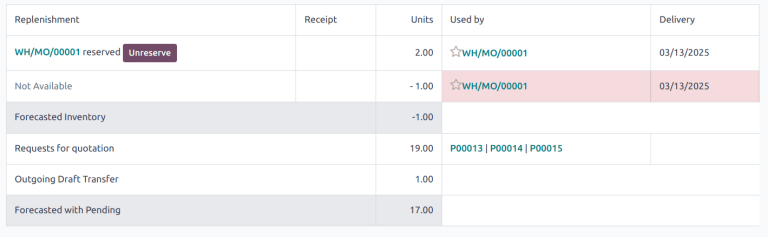
A negative forecasted quantity indicates that the projected demand exceeds the available and incoming stock at a given point in time. This could occur because the SOs (sales orders) or MOs (manufacturing orders) require more stock than is currently available or expected, or because of delays in the shipping or manufacturing process.
Whatever the cause, when negative numbers are displayed on the forecast report, it serves as an early warning, allowing business to take preventative action. This can include:
- Prioritizing specific sales or production orders.
- Adjusting procurement strategies to expedite purchase orders.
- Manage customer expectations by proactively communicating the possibility for delays.
Split orders
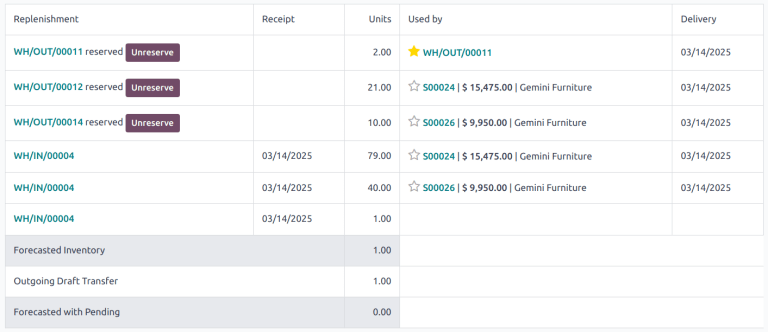
In the example below, there is not currently enough stock of a product, [Cabinet with Doors] to fulfill the multiple sales orders. The current stock has been reserved for a shipment, [WH/OUT/00011], and the remainder has been split between the two orders. The remaining stock is expected with [WH/IN/00004]. Once received, they are the separated out to cover the remaining orders.
Late receipt
The replenishment table can be used to determine whether an incoming shipment arrives in time to fulfill an order. For example, a SO (sales order) is displayed with a Delivery Date for today for five [Cable Management Boxes]. The current on hand quantity is zero. A PO (purchase order) has been confirmed, with the expected arrival three days from today.
The forecasted quantity for today shows [-5], because the confirmed demand is five, but the current stock on hand is zero. Since the Receipt date is after the Delivery Date, the shipment is late.
This can be an indication to either expedite the current shipment, if possible, or reschedule the delivery date for the SO (sales order).